
The Buttonhole
Once a quiet marker of intention, the buttonhole has become an afterthought. And yet, in its scale and symbolism, it remains one of the most expressive floral gestures within a wedding — a small act of care worn close to the heart.
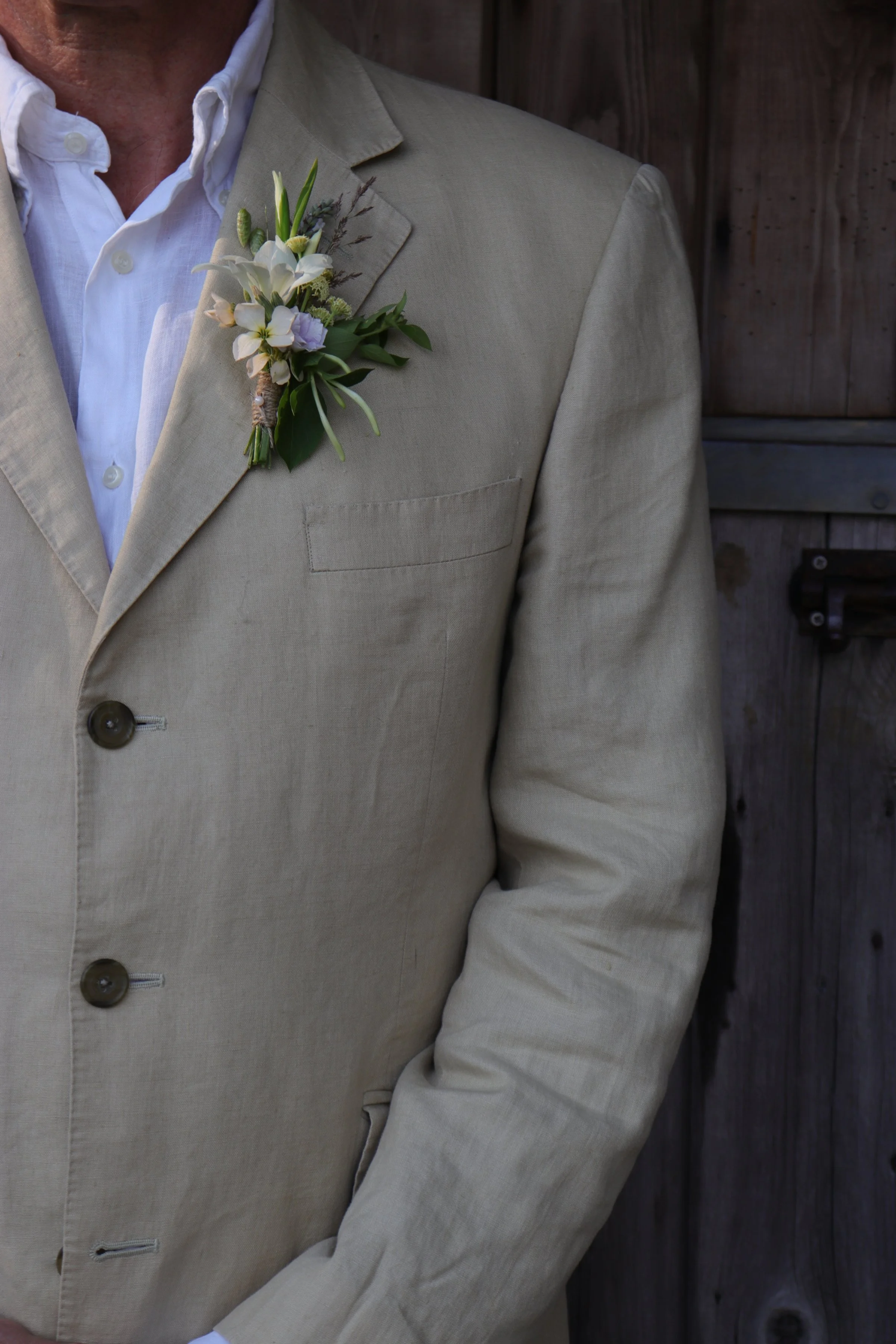
Historically, the buttonhole carried meaning beyond decoration. In the 18th and 19th centuries, flowers worn at the lapel signalled allegiance, sentiment, even protection; herbs and blooms were chosen for their associations as much as their beauty. The tradition endured into courtship rituals, where a single flower, offered and then worn, became a visible sign of affection and regard. In this sense, the buttonhole was never merely ornamental — it was communicative.
Today, when weddings are planned with such attention to the bride’s bouquet and the bridesmaids’ flowers, the buttonhole offers a rare opportunity for balance. Thoughtfully composed, it becomes a miniature bouquet — a distillation of the wider floral language, scaled to the body and the moment. For the groom and his groomsmen, it is a way of participating fully in the visual and symbolic life of the day, rather than standing adjacent to it.
As with all good floristry, the success of a buttonhole lies in its restraint. A single garden bloom, a sliver of foliage, a hint of scent — chosen with the same care as any larger arrangement. It is a detail that rewards close looking, one that carries both intimacy and intention.
In recovering the buttonhole as a considered element of the wedding day, we return to an older understanding of dress and ritual — where flowers were not accessories, but signs. Small in scale, perhaps, but rich in meaning.